Think about how much of your day brings your body forward.
We sit at computers, look down at phones, drive, read, cook, garden, and reach toward the people and things that need our attention. Little by little, the shoulders can begin to round and the chest can feel closed.
And sometimes we close inward for reasons that have nothing to do with a screen or a steering wheel. Stress, sadness, uncertainty, and loss can leave us feeling protective of the heart space.
That is one reason chest opening postures can feel so valuable. They give us an opportunity to move in the opposite direction, physically and emotionally.
I Thought Chest Openers Were No Big Deal
This understanding is personal for me.
When I was in yoga teacher training, and my head instructor guided us into a deep chest opening pose. At the time, I did not think chest openers were a big deal. I certainly did not expect what happened next.
Tears began rolling down my face. And I experienced an incredible feeling of relief.
At that point in my life, I had two young boys at home at a difficult age, always fighting and challenging me. And my marriage was being challenged like never before as well. I was struggling. I thought I was doing a wonderful job of holding everything together. I was taking care of our home, working, and showing up for my family while telling myself that I could handle it all.
What I did not realize was how much I was holding inside.
Something about opening the front of my body in the chest opener pose gave me permission to feel what I had not allowed myself to feel in a very long time. It gave me an opportunity to recognize how much I was carrying and how difficult that time really was. And that gave me an incredible feeling of relief.
That moment did not solve everything, but it helped me become more honest with myself. It allowed me to ask questions I had been avoiding: Am I really happy? What am I holding back? What needs to change?
I do not believe that one yoga pose changes your life or fixes what is difficult. But I learned that the body can sometimes reveal what the mind has worked very hard to contain. A chest opener can create a moment of space, and sometimes that space allows us to feel, acknowledge, and begin considering what we need.
That day in teacher training, chest openers became much more than a stretch for me. They became an invitation to stop holding everything so tightly and open myself to another possibility. To this day when I do a chest opener, I remember that feeling. And the opportunity it offers to let go.
What Chest Openers Offer the Body
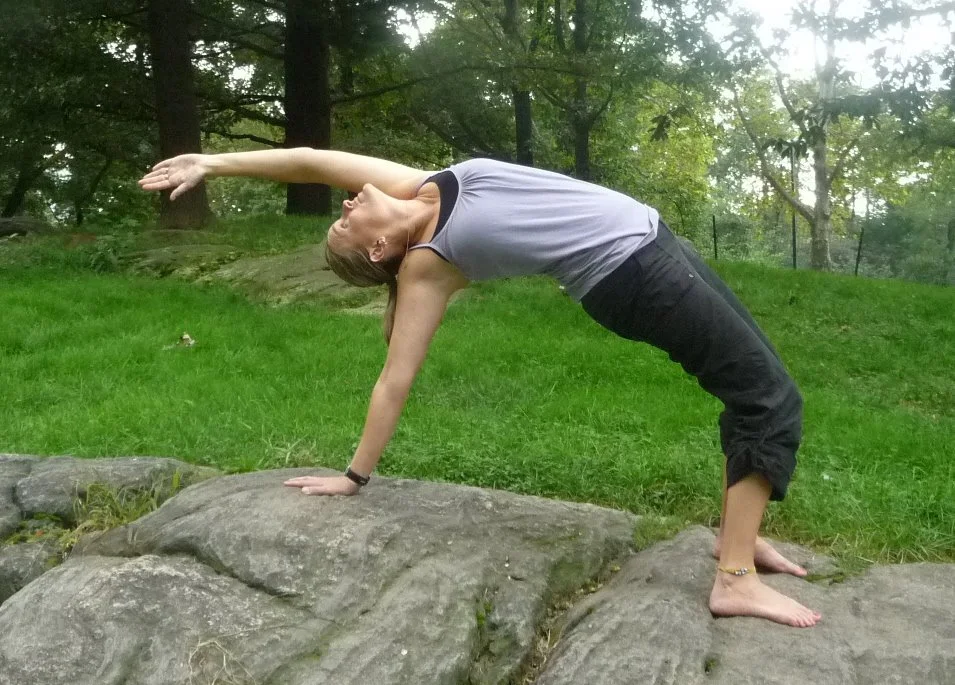
Chest openers encourage movement through the chest, shoulders, and upper back. They stretch the muscles across the front of the chest, invite the shoulder blades toward one another, and help us explore a more upright posture.
Practiced gently and consistently, this kind of movement can support:
* Mobility through the shoulders and upper back
* More space across the front of the chest
* Awareness of habits that pull the body forward
* A fuller, more expansive feeling as we breathe
* Greater ease in standing or sitting upright
This is not about holding yourself rigidly or deciding that one posture is always “good” and another is “bad.” Our bodies need variety. If much of your day happens in a forward position, a chest opener gives your body another direction to explore.
The Emotional Side of Opening
The way we hold ourselves and the way we feel are connected, although one does not offer a quick cure for the other. Research comparing upright and slumped postures suggests that a more upright position may support mood, confidence, and resilience during stressful moments.
There is also something meaningful about the intention behind the movement.
When we gently lift the chest, broaden across the collarbones, and create space around the heart, we are practicing openness. We are not forcing ourselves to feel cheerful or pretending that something difficult did not happen. We are noticing whether we can soften the protective shape, breathe a little more freely, and remain open to what is still here.
Bridge Pose Without Getting on the Floor
Traditional Bridge Pose is practiced on the floor with the hips lifted. That version may not feel accessible or appealing to everyone.
A chair offers another way to explore the same chest opening intention.
Come toward the front edge of your chair and bring your hands behind you. Depending on what feels best for your wrists, you can place your hands on the seat, hold the edge, or reach for the back of the chair.
Draw your shoulder blades toward one another and lift your chest. Pause there and notice what you feel. This may be the complete posture for you today.
If you want to explore more, press down through both your hands and feet. You might shift some weight out of the chair, or you might lift farther. Keep weight in your feet so the pose does not become entirely supported by your hands.
When you are ready, return slowly to the chair. Fold forward afterward and give your body time to soften and rest.
Opening Does Not Mean Forgetting
There are seasons when opening the heart feels natural, and seasons when closing inward feels safer.
If you are carrying grief, change, or the ending of an important chapter, a heart opening posture will not take that away. That is not its purpose. It can offer a quiet moment to acknowledge what you are carrying while creating a little room for breath, connection, meaning, and possibility.
That same intention is at the heart of Opening to Joy Again: Finding Your Way Forward After Loss, the retreat Lynda, my “other” mother, and I are offering on Saturday, October 3, 2026. The day is not about getting over your loss or leaving behind something that mattered. It is a supportive space to honor what has been while gently opening to what may still be possible.
Learn more about Opening to Joy Again
Your Practice This Week
Try the chair variation of Bridge Pose and notice more than how far you move.
Notice your breath. Notice the space across your chest. Notice whether the posture feels energizing, vulnerable, freeing, or unfamiliar. There is no right response.
You do not have to force yourself open. Begin where you are and allow one small movement to create a little more space.