Stop treating your beliefs like facts.
“I can't lose weight because I'm in menopause.”
There. I said it like it was a fact. But it's not a fact. It's a belief.
And I can say it with so much certainty that I stop questioning it.
But what am I doing when I decide I already know what's possible for me?
We've been exploring beliefs in the Authentic Living Circle through the book Beyond Belief by Nir Eyal. One idea has given me a lot to think about: our beliefs are tools.
A belief doesn't have to be absolutely true or absolutely false for us to examine it. Instead, we can ask a different question:
What is this belief helping me do? And what might it be keeping me from doing?
Before we can ask those questions, though, we have to notice what we've come to accept without questioning it.
I Start Noticing Everything That Agrees With Me
When I treat “I can't lose weight because I'm in menopause” as a fact, I begin to see support for it everywhere.
I notice the research that agrees with me. I notice other people saying the same thing. Each time, I have another reason to tell myself, See? I knew it.
And I may pay less attention to anything that invites me to think differently.
We can do this with all kinds of beliefs.
He always does that.
I could never do that.
I'm too old for this.
Once we're certain, we may stop being curious about what else could be true.
Then I Begin to Expect the Same Result
The next thing that happens is that my belief shapes what I expect.
If I try something and it doesn't work the way I'd hoped, I take that as confirmation.
There it is again. I knew this wouldn't work for me.
One disappointing experience can become evidence for a much bigger conclusion about who we are or what's possible.
Maybe you've tried meditation and found your mind wandering.
Does that mean your mind is too busy to meditate?
Or does it mean your mind wandered during that particular practice?
Those two ways of describing the same experience leave us with very different possibilities.
Eventually, I May Stop Trying
This is the part that really gives me pause.
If I've already decided that something can't happen, why would I take a step toward it?
What's the point? I already know how this will turn out.
The belief begins to make the choice for me.
I may never explore another approach, ask another question, or find out what support is available.
That doesn't mean every obstacle can be thought away. In my example, I'm questioning the certainty of “I can't.” I'm not promising myself a particular result.
I simply want to leave room to learn about what might be possible for me.
Is This Belief Limiting Me or Liberating Me?
Thinking of beliefs as tools gives us another way to look at them.
Instead of asking only, “Is this belief true?” we can also ask:
Is this belief limiting me or liberating me?
A liberating belief isn't necessarily a more positive belief. It doesn't require us to pretend something is easy or convince ourselves that we'll get the outcome we want.
It simply leaves room for curiosity, possibility, and choice.
“I'm too old for yoga” might become:
I could find out what a gentle yoga or chair yoga practice would look like for me.
“My mind is too busy to meditate” might become:
I can be curious about what happens when I practice, even with a busy mind.
And “I can't lose weight because I'm in menopause” might become:
My body has changed, and I can be curious about what supports it now.
None of these beliefs guarantees an outcome.
They simply give us somewhere to begin.
A Practice for This Week
This week, notice one sentence you repeat to yourself with certainty.
Listen especially for words like always, never, and can't.
Then ask yourself:
Is this a fact—or is it a belief?
Is this belief limiting me or liberating me?
What might become possible if I were willing to question it?
You don't have to replace it with a new belief today.
Awareness comes first.
Notice the belief. Get curious about it. And leave a little room for something else to be possible.
What Needs Your Attention Now?
Our beliefs influence more than what we think. They influence where we put our attention, what we prioritize, and the choices we make.
So perhaps there's another question worth asking:
What needs your attention now?
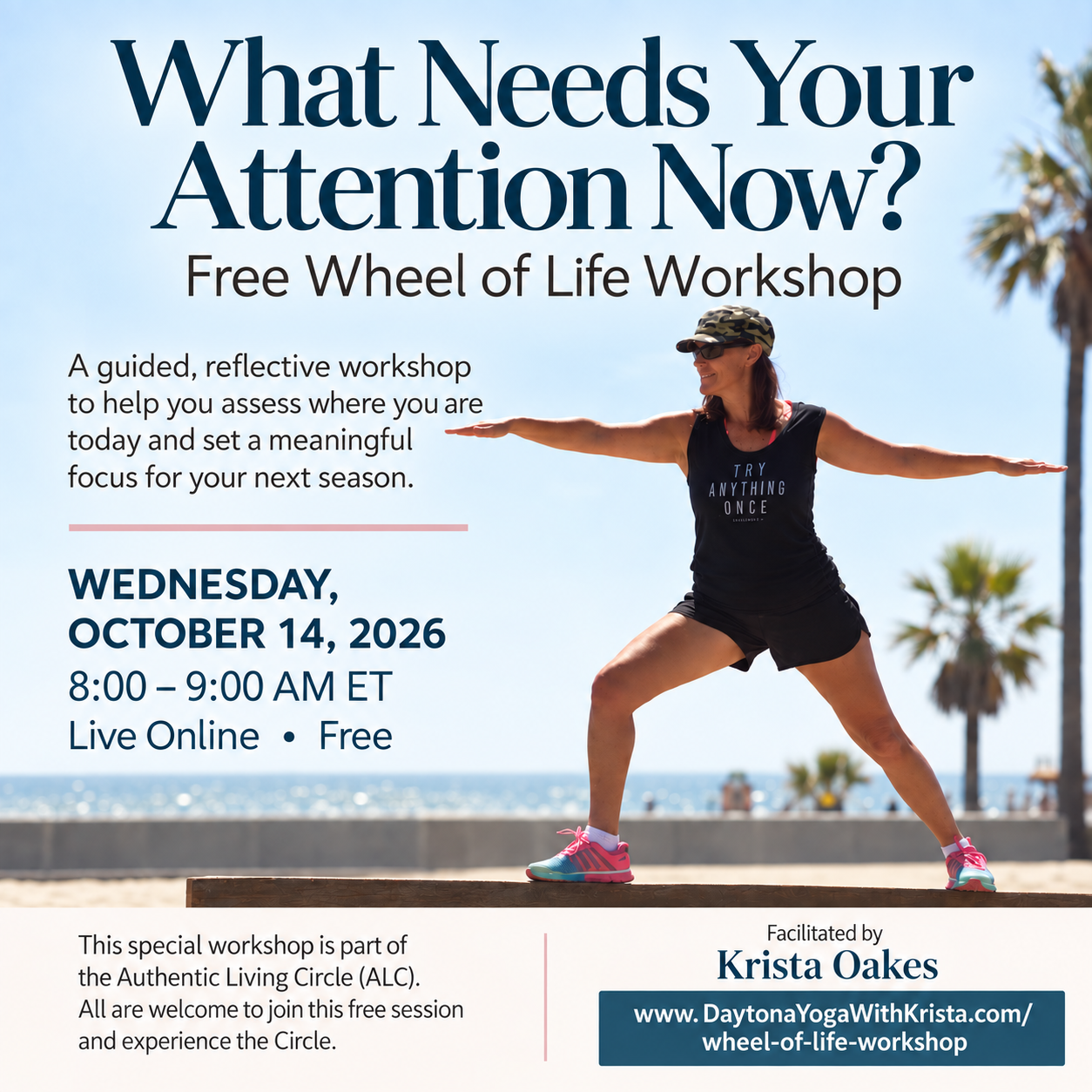
I'd love to explore that with you in my free workshop, What Needs Your Attention Now? | Free Wheel of Life Workshop, on Wednesday, October 14, from 8–9 a.m. Eastern, live on Zoom.
I'll guide you through the Wheel of Life, a visual reflection on the different areas of your life. You'll choose one area you want to give more attention to and one practical action you can take.
The workshop takes place during an Authentic Living Circle gathering, so you'll also have an opportunity to experience the community.
Sharing is optional, and you're welcome to come for the workshop without any obligation to join the Circle. If you'd like ongoing support afterward, I'll share how you can continue with us.