
As a yoga teacher, I often see students close their eyes during practice. They want to go within, quiet some of the distractions, and pay attention to what they feel.
I understand that intention. But while they're turning their attention inward, I'm paying attention to something else, too: are they staying steady?
Sometimes people don't realize how much more challenging a practice becomes when they close their eyes. The pose hasn't changed. Their feet haven't moved. But something they were using to help them balance is no longer available.
That gives us something interesting to explore.
Balance is more than standing on one leg. We can challenge it by changing where we look, how we stand, or the surface beneath our feet. And when we make those changes intentionally, we have an opportunity to notice what helps us feel steady.
Why does closing your eyes affect your balance?
Your brain uses information from your eyes, your inner ears, and the muscles and touch sensors in your legs to help you stay balanced. Your eyes give you a view of where you are in relation to the room around you.
When you close your eyes, that visual reference is no longer available. You have to rely more on the other signals your body is receiving, so even standing in the same position can feel less steady. That's why I pay attention when students close their eyes during a standing practice.
Closing your eyes to go inward and closing them to deliberately explore balance may look the same from the outside. But knowing what you're asking your body to do changes how you approach it.
You can choose your support. You can decide how much challenge is appropriate. And you can keep your eyes open whenever that is the better choice for you.
Both feet can stay on the floor
We often picture a balance practice as standing on one leg in Tree Pose. But you may have noticed that Warrior I can challenge your balance with both feet on the floor.
This week's practice offers another way to explore that idea.
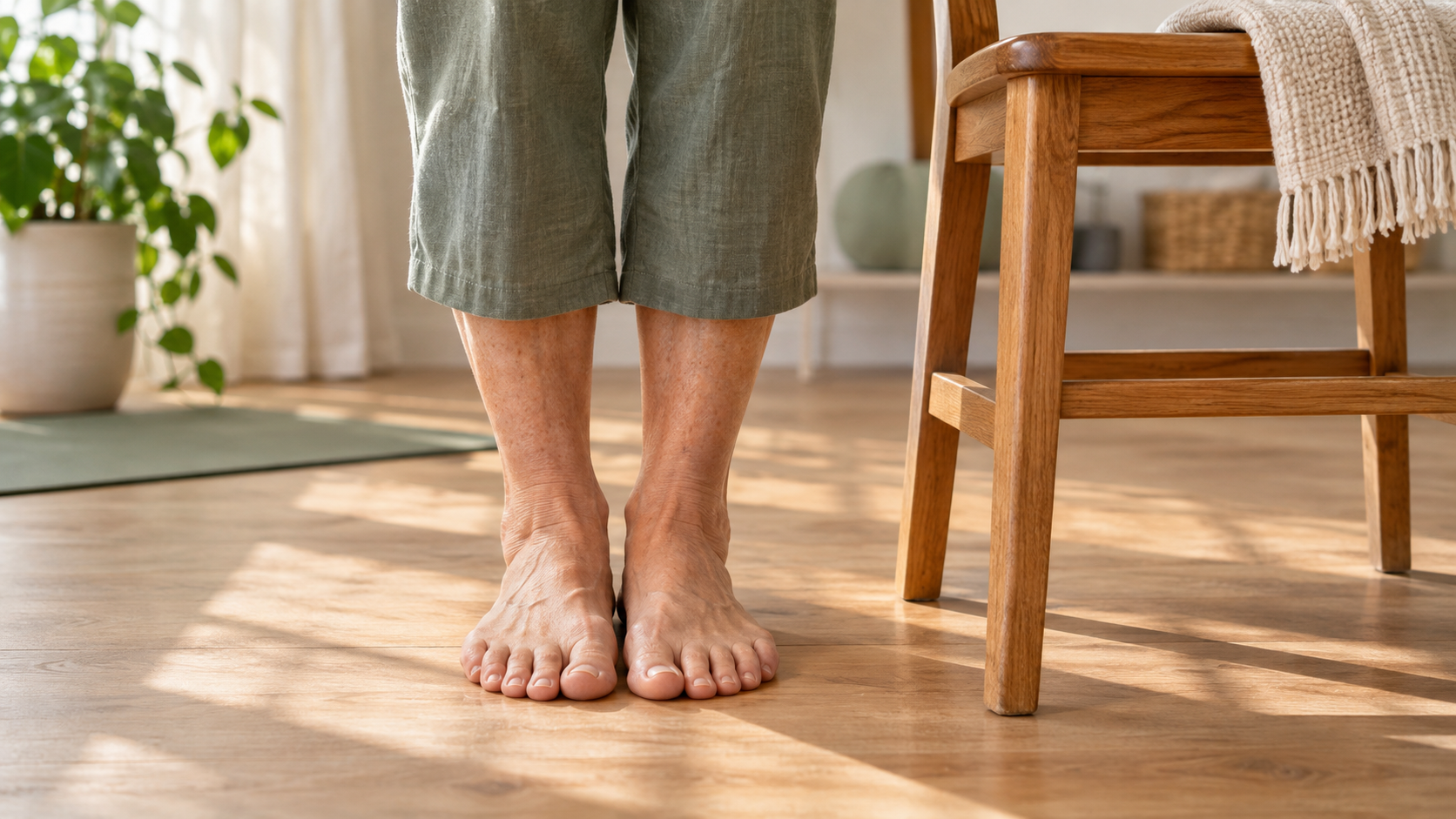
With a sturdy chair, wall, or counter for support, bring your feet a little closer together, only as close as feels steady for you. Stand comfortably tall and look ahead. Keep a hand on your support as needed.
Then explore one small change at a time:
Turn your head gently to look to one side, then return to center.
Look to the other side and come back.
If comfortable, look slightly up, return to center, then look slightly down.
Pause with your gaze ahead and notice what changed.
Did one direction feel different from another? Did you find yourself using your support a little more?
You don't have to close your eyes to discover something here. Changing where you look may already give you plenty to work with. If you feel dizzy or unsteady, stop and return to a comfortable, supported position.
For an eyes-closed progression, keep secure support and get guidance about whether it's appropriate for you. There is no need to let go to make the practice count.
The surface beneath you matters, too
There's another way to change the challenge that I don't demonstrate in this week's video: change the surface you're standing on.
A firm floor gives you a stable surface beneath your feet. A softer surface, such as a thicker mat or a folded mat, can make it harder to feel steady, even when your feet stay in the same position. Changing the surface is another way to change the balance challenge.
That's something to explore with guidance and stable support, rather than a reason to add an unstable surface and close your eyes at the same time. A towel or folded mat also needs to stay secure beneath you, without slipping or creating an edge to trip over.
The point is to recognize that there are different ways to practice. More difficult isn't automatically more useful for your body today.
Bring that attention into your day
This time of year can bring more shopping, more errands, and more things competing for our attention. We may be looking at something on a shelf while our feet are moving somewhere else, or thinking about the next stop as we walk through a parking lot.
In class, we give ourselves time to notice how we're standing and moving. We can bring some of that attention into those ordinary moments, too.
Balance practice is one part of caring for ourselves. Falls can have several contributing factors, so no single exercise is a guarantee against falling. Strength and balance practice can help, but vision, medications, and tripping hazards at home also deserve attention.
For this week, begin with something you can notice. How does it feel to stand with both feet down? What changes when you turn your head? What support helps you feel comfortable exploring?
These are the kinds of things we make room for in gentle yoga and chair yoga. You don't need to make your practice look like someone else's. You need room to discover what works for you.